
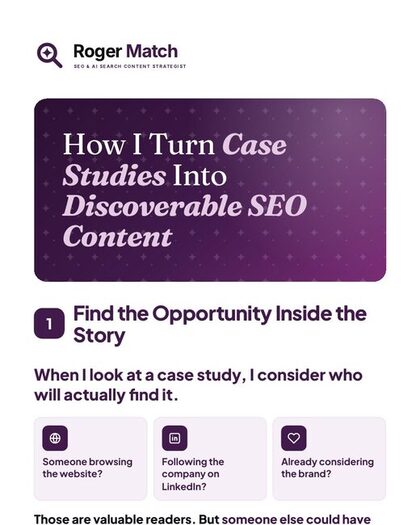
Case studies are some of the best content a brand has. But who actually finds them?
Usually it's people who already know you. They browse your website, follow you on LinkedIn or are already considering you.
Meanwhile, someone else has the exact problem your customer solved and never comes across the story 🙂
Why reach beyond people who already know the brand
Case studies work. In the Content Marketing Institute's 2025 B2B research, 53% of B2B marketers named case studies and customer stories among their most effective content formats.
The problem is timing. In 6sense's 2025 Buyer Experience Report, 94% of buying groups had already ranked their preferred vendors before first contact with a seller. And discovery is moving into AI: in a Semrush survey of US consumers, 43% said they'd discovered a new brand through an AI tool.
If your story only reaches people who already know you, you're missing the ones still figuring out their options.
My 6-stage process
1Identify problems other customers might have
I read the case study and pull out the problem, what caused it, what helped and the evidence I can use. For example, a case study about delivering more creative assets might reveal that slow approvals were holding production back. That gives me a possible article about reducing approval delays.
2Turn the problem into searchable topics
Then I think about what someone would search for if they had that problem but had never heard of the company. "Approvals delayed delivery" becomes "How to reduce creative approval bottlenecks." "Demand outgrew production capacity" becomes "How to scale creative production without losing quality."
3Decide which topics deserve an article
Not every insight needs its own page. I check search interest, reader intent, business fit, existing coverage and how much useful evidence the case study adds.
4Build a complete answer
I write for the person with the question first: a direct answer, practical steps and trade-offs, the customer example where it actually helps and a useful next step.
5Introduce the company through its work
The brand shows up when its contribution becomes relevant. What did it help the customer change, and which service or expertise made that possible? I keep the customer's context attached to the results, because one successful project is an example to explain rather than an outcome to promise everyone.
6Check whether it reaches the right people
I track non-branded discovery, topic coverage, mentions and citations in AI answers, visits to the case study or service page and the inquiries it helps create. Rankings are only part of the picture.
The PDF walks through the full example and includes my pre-publish checklist.
Download the free PDFBefore you publish
These are the questions I ask every time:
- Does the topic make sense without the brand or customer name?
- Does the article help someone solve or understand the problem?
- Does the case study support the advice being given?
- Are the results presented with their original context?
- Does the brand introduction follow naturally from its contribution?
Where this fits in my work
This is one of my favorite ways to grow non-branded search and AI visibility for B2B brands. It works even better with SME interviews to add first-hand detail, and with a clear update process to keep it accurate. You can see how I work here or read more about me.